Boiling kills bacteria, viruses, and parasites (a rolling boil for 1 minute, 3 minutes above 6,500 feet elevation, per CDC guidance), but does nothing for chemicals, heavy metals, or sediment. Purification tablets do roughly the same job as boiling, chemically, with a longer wait time. A filter removes sediment and, depending on pore size, bacteria and parasites (some carbon models help with chemicals too), but doesn’t reliably stop every virus the way boiling does. None of the three fixes cloudy water on its own; filter out visible particles first, then treat.
People treat this like a brand debate (which product is “best”) when it’s really a question of what’s actually wrong with your water and what gear you have on hand. This isn’t medical advice; if you have specific health conditions that affect what water treatment is safe for you, talk to your doctor rather than relying on general guidance alone.
In this guide
What each method actually removes
Here’s the honest comparison, without a specific product to sell you:
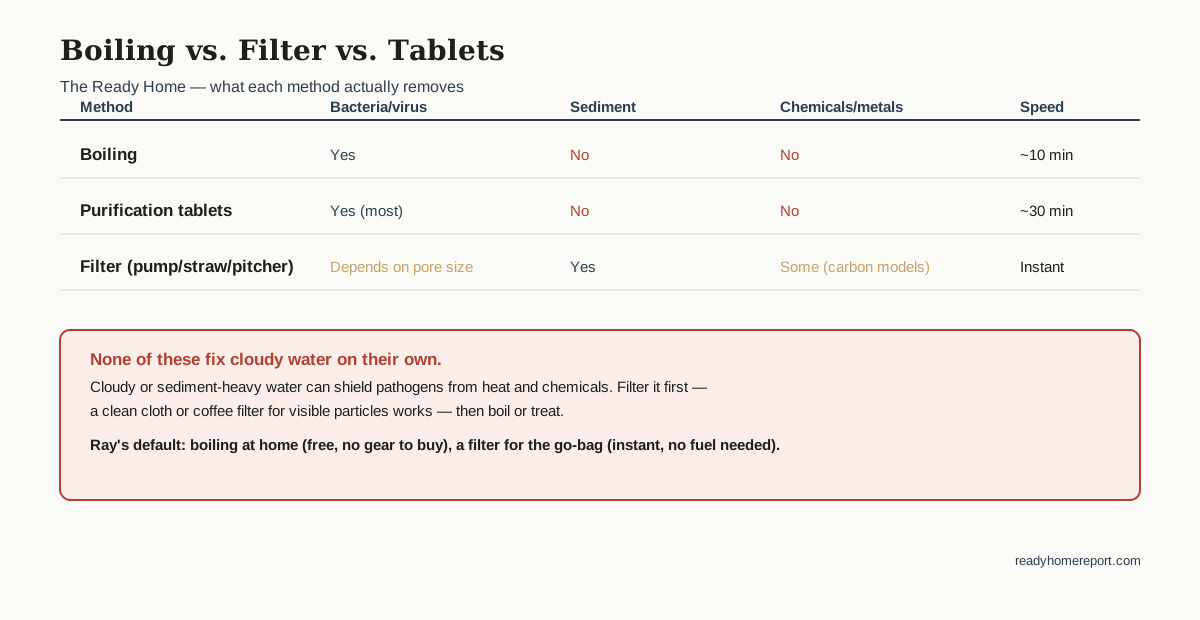
| Method | Bacteria/virus | Sediment | Chemicals/metals | Speed |
|---|---|---|---|---|
| Boiling | Yes | No | No | ~10 min |
| Purification tablets | Yes (most) | No | No | ~30 min |
| Filter (pump/straw/pitcher) | Depends on pore size | Yes | Some (carbon models) | Instant |
The step that comes before all three
Cloudy or sediment-heavy water can physically shield pathogens from heat and from chemical treatment. The microorganisms hide inside particles the boil or the tablet can’t fully reach. If your water source looks cloudy, filter it through a clean cloth or a coffee filter first to pull out visible sediment, then boil or chemically treat what’s left. Skipping this step is the most common mistake people make with backup water treatment, and it’s the one that actually matters.
Which one to actually use, and when
At home, with power out but the stove working (gas, or a camp stove used safely outdoors), boiling is free and requires no gear you have to buy or store. It’s my default. For a go-bag, car kit, or a situation where you can’t safely build a fire (no power, no gas, actively evacuating), a filter wins on speed: no wait time, no fuel. Purification tablets are the compact backup for a kit where weight and space matter more than taste; they work, but plan on the wait time and a slight chemical taste most people notice.
One contraindication worth knowing before you buy: the CDC advises against iodine-disinfected water for anyone who is pregnant, has a thyroid condition, or has an iodine sensitivity, and against drinking iodine-treated water for more than a few weeks at a stretch. Chlorine dioxide tablets don’t carry that restriction and are the more common option for that reason.
None of these three replaces the water you already have stored and sealed. See how to store water at home for that system. Treatment is what you reach for when your stored supply runs out or when you’re pulling from a source you don’t already trust, like during an active boil water advisory. Not a substitute for storing water properly in the first place.
FAQ
Is boiling or a filter better for emergency water?
Boiling reliably kills bacteria, viruses, and parasites but doesn’t remove chemicals or sediment. A filter removes sediment and, depending on pore size, most pathogens, but is less reliable against viruses than boiling. Each has a place depending on your situation.
Do water purification tablets work as well as boiling?
For biological contamination, yes, roughly. Most tablets handle bacteria, viruses, and parasites similarly to boiling, just with a longer wait time (around 30 minutes) and a noticeable taste.
Can a water filter remove chemicals and heavy metals?
Some filters, particularly carbon-based ones, reduce certain chemicals and improve taste, but this varies by product. Check the specific filter’s certification rather than assuming.
Why should I filter cloudy water before boiling it?
Sediment and cloudiness can shield pathogens from heat, reducing how effective boiling is. Filtering out visible particles first with a cloth or coffee filter makes the boil actually reliable.
What’s the best emergency water treatment method for a go-bag?
A compact filter is usually the best fit for a go-bag: no wait time, no fuel required, and it works immediately, which matters when you can’t safely build a fire.
Are purification tablets safe for everyone?
The CDC advises against iodine-disinfected water for anyone pregnant, with a thyroid condition, or with an iodine sensitivity. Chlorine dioxide tablets don’t carry that specific restriction.
Full water storage system is in How to Store Water at Home.
This article is for general preparedness education and follows official guidance (FEMA, CDC, CPSC, NWS, USDA) on safety points. In any emergency, instructions from local officials always come first.